Posts Tagged ‘Tao’

many words, but only one reality

June 29, 2012
English: basmallah , , in the name of Allah (God)

English: basmallah , , in the name of Allah (God) (Photo credit: Wikipedia)

There is only reality. Can you name anything that exists that is not part of reality? Can you name any part of reality that does not exist?

Language is just an aspect of reality. Myths and lies and fiction and jokes and pretense and denial are all actual patterns of reality. Words are real words. Dreams are real dreams. Hallucinations are real hallucinations. The words “unreality” and “realities” are real words, but there is no such thing as unreality and there is not more than one reality. There is only reality. There is only one reality.

There is no reality except for reality. There are not two or more isolated realities. There is only one reality, which is eternal and continuous and boundless and omnipresent and omnipotent.

There is not one reality in conflict with another. There is only one reality.

Now, while all of that is relatively simple logically, lots of people can be very confused about the sheer simplicity of reality. Of course, confusion is also a real pattern in reality.

Spirituality and religion are about resolving basic confusions about language. However, many people may not be familiar with that idea and may confuse spirituality and religion for something that they are not. Or perhaps spirituality and religion are about creating confusions about language, but there are some major exceptions to that premise.

Holy Trinity by Fridolin Leiber (1853–1912)

Holy Trinity by Fridolin Leiber (1853–1912) (Photo credit: Wikipedia)

Let’s review one of the most common spiritual words: God. I assert that God is actually just another word for reality, even if people may confuse the word God to refer to something else. In considering this idea, let’s review three simple statements about reality:

“There is no reality except for reality. There are not two or more isolated realities. There is only one reality, which is eternal and continuous and boundless and omnipresent and omnipotent.”

Now, let’s replace the word reality with the word God and notice if any of this sounds familiar to you: “There is no God except for God. There are not two or more isolated Gods. There is only one God, which is eternal and continuous and boundless and omnipresent and omnipotent. God can be represented in multiple aspects, such as the three metaphorical archetypes of the Holy Trinity, but that is still monotheism, not polytheism, including the Holy Trinity of Vishnu, Indra, and Brahman.”

trinity-brahma-vishnu-and-shiva

If none of the above sounds familiar to you, you may not be familiar with the major monotheistic religions of Judaism, Christianity, or Islam. Let’s try the same idea with a few eastern religious terms:

“There are not two or more isolated Buddha Natures. There is only one Buddha Nature and it is eternal and continuous and boundless and omnipresent and omnipotent.” That is, generally speaking, the Hindu teaching of Advaita as well as the primary meaning of the word Yoga.

Here’s another similar variation: “The Tao that can be spoken of is just a labeling of the Tao, not the actual fullness of the Tao. There is no Tao except for the Tao.”
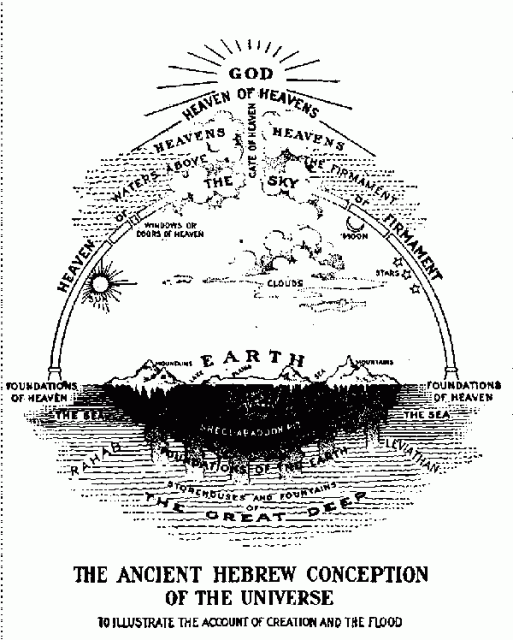
hebrew heaven

Let’s do the same thing with another familiar spiritual word: heaven. “There is only one heaven, which is eternal and continuous and boundless and omnipresent and omnipotent. There are not two or more isolated heavens. There is no heaven except for heaven.”

We know that ancient people used the term heaven in two distinct ways: to reference the sky and outer space where clouds and the sun and moon and planets and stars can be seen, and to reference some place or experience of total acceptance and bliss. The sky is also boundless and eternal and so on, but the basic idea of astrology is that heavenly activity (such as sunlight or the phase of the moon) influences earthly phenomenon, such as the varying warmth of the cycles of day and night or of the seasons, as well as the cycle of tides and menstruation.

Now, let’s consider another two phrases common to Christianity: the Kingdom of God and the Kingdom of Heaven. The English word Kingdom is also easily replaced with “realm” or “reality.”

The realm of reality is like a mustard seed or a vine. The small seed produces a huge tree with many branches and limbs. There is no part of the realm of reality that is outside of reality. Reality is inclusive, like every branch of a vine includes the vine and the vine includes every branch. Reality abides in each of us and we each abide in reality. We cannot be separated from reality, so it is meaningless to speak of reconnecting to reality. The realm of reality is within you. The realm of reality will not approach you from the outside. You cannot enter in to it like a man walking through a doorway. I am reality and so are you. Before Abraham was, reality exists.


Jesus was asked which teaching is the greatest, and he quoted the Old Testament, saying “Hear ye, O Israel, reality is continuous, whole, holy, unending, perfect, pure, complete. Study reality with all of your heart and all of your might and all of your life.”

The one who had questioned Jesus then said, “Rabbi, you speak the truth. There is only one reality and there is nothing outside of reality.”

For those familiar with the New Testament, they can find the common mistranslations of the simple ideas of Jesus. Note that any translator who did not understand the simplicity of the teaching would not be able to use a modern English word like reality and would likely use a much broader translation. This would be like someone translating all of the following three Greek words (agape, eros, philos) in to the same English word (love).

Imagine someone trying to translate the words calculus, trigonometry, and algebra when they do not really understood anything but arithmetic. In that case, they would call all forms of math by the single label “math.”

Likewise, in any language, there are many names for different aspects of reality. Brahman, Allah, Yahweh, and God are not referencing different ideas. They all reference the boundless reality which includes all the forms or identities referenced by language. All of the branches of reality are reality already.

Heaven (or Nirvana) could be a reference to the direct experience or realization that reality is an infinite, continuous, living process. Language, which a a function of reality, only labels different qualities of reality. Language does not divide or isolate the continuous unity of reality in to multiple, disconnected “realities.” Identifications in language are just real identifications in language.


In the beginning, reality spoke language in to existence. Language was with reality, within reality, and of reality. Language was not separate from reality.

Compare the simplicity of that statement with the common mistranslations of  John 1:1. It is through a fundamental confusion about language that naive people can innocently but foolishly or vainly believe in a schizophrenic or broken reality.

Reality cannot be broken. There is nothing except reality, so there is nothing to break it.

God cannot be divided. There is nothing except God, so there is nothing to divide God. Even language (Logos) is an aspect of reality, of God, of the branching of the living process of the eternal, omnipotent, omnipresent One.

For those who argue over the existence of language, God, or atheism

April 5, 2012
Photo of Jonathan G. Meath portraying Santa Cl...

Photo of Jonathan G. Meath portraying Santa Claus. Date approximate. (Photo credit: Wikipedia)


For those who argue over the existence of language
Does language exist? Sure, we can perceive patterns, so we know that perceiving exists and we also know patterns of perceiving exist, but what about language? Does it exist or not?
For those of us who can not only hear but also are fluent in a particular language being spoken, we can perceive patterns of sounds and interpret them in to words and then in to sequence of words that produce stimulation of things like neurons that trigger memories. We can label all of that process as language.
For those of us who can not only see but also can read, we can perceive patterns of shapes and interpret them in to letters and make words out of them and then we can label that literacy, which is also language. However, literacy is a huge technological advance over spoken language.
We can count all numeric symbols as literacy and we can name all written symbols to also be part of literacy. We can even include in our definition of language things like physical gestures, such as waving or nodding or even complex things like the signals that officials in sporting events use.


So, for sake of argument, let’s presume for at least a moment that there is such a thing as language or at least there could be. Now, what would be some of it’s attributes?
Is language an individuality as in a person or isolated organism? Language clearly is not exclusive to any specific individual or organism. We can call language transpersonal (or just non-personal or impersonal).
Is language temporary? Language is the source of all units of time, so we could even say that language is beyond time, is the source of time, and was prior to time. We could say that language is eternal, that language is both the beginning and the end, that before any particular identifying in language existed, such as “Abraham,” language is already present.
We could say that language is the root of all identifying and of all identities. We could say that language is the source of all linguistic events or processes, such as communication or interpretation or translation.
We could make lots of comments about language. All of the comments would be instances of language already. We might even say that “if you are clear about the foundation of what language is, then all of the rest is mere commentary.”
Bible

Bible (Photo credit: Sean MacEntee)

Now, if you happen to be familiar with certain linguistic constructions that are popular within a branch of language called Christianity, then you may recognize many of the above references to the ancient spiritual texts of Christianity, Judaism, Hinduism and so on. So, with that in mind, consider the following scenario.
Along time ago, there once lived a man named Santa Claus who talked a lot about a great secret. Certain people understood some of what he said and a few people understood a lot of what he said, but he was basically considered to be very weird and unusual and odd and abnormal. He occasionally said really bizarre things like “Knowing the great secret is the most important thing that you can do. Here are some of the infinite qualities of the great secret, but these are only a few of them. First, the great secret is eternal. When the first distinctions were made between heaven and earth, the great secret was already there and the great secret was the process by which the first distinctions in language were made, for the distinctions of language are language and of course language is in them and those distinctions are in language. By the way, language is the great secret and it is not really all that secret and possibly not all that great, but I had to say something to get your attention and if I have your attention now, then whatever I said worked to get you here, right? Anyway, the great secret is not just an individual, but it is within every individual just as within every branch is the life of the tree which gives life to the branches. Further, when you recognize the fundamental authority of the great secret of language, then any secondary authorities or instructions will instantly be recognized as merely formations of language, which is the great secret. Any formations in language are not themselves the great secret. Anything that can be spoken is not the great secret, which I like to call Tao.”
Now, all of that was very strange and intriguing to some folks. So, they talked about what Santa Claus had said and then, perhaps only a few decades later, they wrote down their best recollections of what he had said, plus some of their own commentaries and their letters to each other. They called themselves titles like Apostles and Prophets and Christians and they collected their various written records in to scrolls and books and called them things like the Bible and Torah and Talmud and Gitas and Sutras and Taoist Classics.
Then, along came a four year-old who was assigned by some king the task of making a single authorized translation of those ancient writings in to the English language from Greek. The four year-old was not Greek, by the way, but she insisted that she was a very big girl now that she was “this many” years old and she asserted that she was very smart and of course she could make an excellent and complete translation of these books. It is not like they were about something obscure and subtle like algebra or biochemistry or mythical archetypes of psychological astro-theology, right?
So, anyway, she wrote about a category in language called Logos and she translated that word as “Word” instead of as language or linguistics or “the great secret.” Then for hundreds or even thousands of years, lots of people worshiped the words that she wrote and completely missed the “spirit” of the original revelations. Ironically, a lot of what she wrote about was warnings about people worshiping specific words and neglecting the spirit or value of the communication carried through the words.
Logo of the Aston Language Centre

One of the least famous "Logos" in the world, the logo of the Aston Language Centre (Photo credit: Wikipedia)

Isaiah 29:13 The Lord says: “These people come near to me with 

 The Lord says, “These people worship me with their mouths and honor me with
their lips. But their hearts are far from me, and their  
//bible.cc/isaiah/29-13.htm – 17k

Matthew 15:8 “‘These people honor me with their lips, but their 

“‘These people honor me with their lips, but their hearts are far from me These
people honor me with their lips, but their hearts are far from me
//bible.cc/matthew/15-8.htm – 16k

Mark 7:6 He replied, “Isaiah was right when he prophesied about 

He replied, “Isaiah was right when he prophesied about you hypocrites; as it is
written: “‘These people honor me with their lips, but their hearts are far from 
//bible.cc/mark/7-6.htm – 17k

Matthew 15:9 They worship me in vain; their teachings are but 

 but it is in vain they worship Me, while they lay down
precepts which are mere human rules.'” 
//bible.cc/matthew/15-9.htm – 16k

Mark 7:7 They worship me in vain; their teachings are but rules 

 in vain do they worship me, teaching as doctrines the commandments of men.’ … 
//bible.cc/mark/7-7.htm – 15k

Romans 1:21 For although they knew God, they neither glorified him 

 they knew God, but they wouldn’t worship him as  Because that, when they knew God,
they glorified him not  God, neither were thankful; but became vain in their 
//bible.cc/romans/1-21.htm – 17k

Psalm 127:1 A song of ascents. Of Solomon. Unless the LORD builds 

 [A song by Solomon for going up to worship.] If the LORD does not build  Except the
LORD build the house, they labour in vain that build it: except the 
//bible.cc/psalms/127-1.htm – 16k

Hosea 12:11 Is Gilead wicked? Its people are worthless! Do they 

 But the people of Gilead are worthless because of their idol worship If Galaad be
an idol, then in vain were they in Galgal offering sacrifices with 
//bible.cc/hosea/12-11.htm – 16k

Isaiah 44:9 All who make idols are nothing, and the things they 

 The people who worship idols don’t know this, so they are all put  Everyone who makes
an engraved image is vain. The things that they delight in will not profit 
//bible.cc/isaiah/44-9.htm – 16k

Jonah 2:8 “Those who cling to worthless idols forfeit the grace 

 Those who worship false gods turn their backs on all God’s mercies.  They
that are vain observe vanities, forsake their own mercy. 
//bible.cc/jonah/2-8.htm – 14k

Colossians 2:18 Do not let anyone who delights in false humility 

 denial or the worship of angels, saying they have had  making little of himself and
giving worship to angels  the things which he hath not seen, in vain puffed up 
//bible.cc/colossians/2-18.htm – 18k

Isaiah 1:13 Stop bringing meaningless offerings! Your incense is 

 and your special days for fasting–they are all  Bring no more vain offerings; incense
is an abomination to me  New Moon Festivals, your days of worship, and the 
//bible.cc/isaiah/1-13.htm – 16k


Isaiah 29:13 The Lord says: “These people come near to me with 

The Lord says: “These people come near to me with their mouth and honor
me with their lips, but their hearts are far from meTheir 
//bible.cc/isaiah/29-13.htm – 17k

Matthew 15:8 “‘These people honor me with their lips, but their hearts are far from me.


Matthew 15:9 They worship me in vain; their teachings are but rules taught by men.'”


Mark 7:6 He replied, “Isaiah was right when he prophesied about you hypocrites; as it is written: “‘These people honor me with their lips, but their hearts are far from me.


Mark 7:7 They worship me in vain; their teachings are but rules taught by men.’


Colossians 2:22 These are all destined to perish with use, because they are based on human commands and teachings.

Ezekiel 33:31 My people come to you, as they usually do, and sit before you to listen to your words, but they do not put them into practice. With their mouths they express devotion, but their hearts are greedy for unjust gain.

Jeremiah 12:2 You have planted them, and they have taken root; they grow and bear fruit. You are always on their lips but far from their hearts.


Psalm 50:16
But to the wicked, God says: “What right have you to recite my laws or take my covenant on your lips.


Secret Santa (The Office)

Secret Santa (The Office) (Photo credit: Wikipedia)

Gratitude into Action

April 1, 2012
English Language

English Language (Photo credit: Wikipedia)

Gratitude into Action

I almost died. Be clear that I do not mean that something was so funny that I almost died laughing. I mean it literally: the functioning of my organism almost stopped suddenly.

Well, to be even more specific, let’s say that I was very scared. My heart rate shot up, my body eventually relaxed to catch my breath, and then shivers and shaking went through my body as I adjusted to the surge of chemicals like adrenalin.

Can you relate to this? Have you even experienced something similar?

I’ll tell you exactly what happened a little later. Before that, I am inviting you to use your own imagination and intelligence… rather than bias you with the particular details of my own history of a particular case of almost dying- or being suddenly exposed to the possibility of dying… like “ah, I notice that I could have just been killed. How interesting!”

So, you personally would have at least witnessed someone who gets “scared to death,” right? Sure, but not just startled- I mean really clear that their physical organism is temporary, conditional, something that begins and then ends, something that belongs to the earth itself, not to our linguistic ideas, not to our ego or our family or our government, but that ultimately belongs ONLY to God, if you like that word.

Again, I do not mean God as a particular linguistic ideal either, like loving or wise or old and white-bearded like Santa Zeus. No, I mean God as the indescribable, the one word that we know is beyond regular words, the ineffable, the mysterious, the great unknown (uncontainable) that is so far beyond our capacity for language that we can conceptually accept only that it is absolutely beyond our understanding, beyond “what we know that we don’t know.” We have no idea what the word God means, and, in the one exceptional case of this particular word, we actually might just even admit it!

Hebrew mystics have four letters for it, with each letter representing a distinct idea built in to the sequence of four related ideas, but they consider that sequence of letters to be a sacred encoding which is not to be said out loud. The Taoists even directly say this: “the Tao that can be spoken of is not the Tao.”

One cannot meaningfully declare one’s definitions of it. If one defines it with other words, that is not it. I mean by the word God this: THE fundamental linguistic unit that points to the conditionality and inherent emptiness of all other units of language.

Letters and alphabets begin and end (like in the history of a particular species or culture). Formations of an individual word begin and end- like the words “internet” or “blog” or “quark” are rather new while an ancient language that is known to have existed may now be otherwise forgotten, like an extinct species that is now just a distant legend or a big rack of dinosaur bones in a museum.

So, words come and go, and the meanings of words can change. The use and function of a particular word formation is thus ENTIRELY contextual (not inherent).

For instance, the sound of the word “right” means three distinct things. Right is the opposite of left. Right is also the opposite of wrong. Right is even a legal category distinct from privilege or any act that is prohibited or punished (as in some act that is criminalized by law: by the drafting, proposal, adoption, declaration and then the evolving administering of some new law or treaty or amendment or constitution).

However, to someone who does not know the English language, the sound of the word “right” is just a meaningless sound. Ask your pets. Even human infants do not know right from left. We either learn or else we still don’t know, and then we may go senile and forget.

Even the shapes of the letters forming the word “right” are just shapes. Each letter is just a shape. The G and the H do not even have a sound in that word, yet without those silent letters, “rit” is just not spelling it “write.”

So, we can easily demonstrate physically which is “right” and which is left, but there is nothing sacred about those terms. In sailing, we might use the terms “port” and “starboard” to refer to the same or similar distinctions. In other language or contexts, we use other sounds or words or letters or alphabets or encodings.

But the word “God” is not like all these words that are contextual, that is, inherently meaningless. God is not the opposite of the Devil either. I do not mean gods like the archetypical psychological distinctions of mythological astrology. I mean like what the Chinese call the Tao.

Ludwig Wittgenstein

Ludwig Wittgenstein (Photo credit: Wikipedia)

If we had to use a relative term of description to distinguish the term God, we might say that the word God is the opposite of all other words. It’s not like the others at all. Given that, to say anything, we would be limited to all those other words that are like that one, “God is not like those” is really about all we could say.

God is just what “we don’t know that we don’t know.” (I borrow that particular phrasing from

Face portion of a casual photo at a meeting.

Werner Erhard. (Photo credit: Wikipedia)

Wittgenstein… which Werner Erhard and then Landmark Education borrowed in turn- though none of them called it God or anything else, as far as I know.) Other than “we can’t describe it in words,” we obviously can’t say much about it, can we?

So, as I said before, I almost died. Here is what actually happened.

Back in the days of elementary school, Johnny and I were both crammed in to the front passenger seat of his mom’s car. I was sitting next to the door and Johnny was on my left (or, for you boaters, portside of me).

Johnny and I were in our dark blue cub scout uniforms and we were probably late for a cub scout meeting. She was taking a sharp left turn when I found out that I had not closed the passenger door all the way. It may have even been a car in which the door did not actually stay closed. Cars can eventually fall apart, too, you know!

So she’s turning the car left and I’m flying out of the open car door to the right (starboard). Johnny grabs my left hand and then I look down for one of those eternal moments at the hard black pavement speeding by me just a few feet under the soft tissue of my face.

So, maybe I did not quite “almost die.” But I did almost fall out of the car. I was as scared as I could ever recall being as of that time in my life- so not just scared of heights and shakily climbing back down the ladder from the diving board of the “high dive.”

This was not just a recognition of “I’m scared that I could have been hurt.” This was “there were cars and trucks coming from the opposite direction. I could have been run over and smashed like the flattened little animals on suburban and rural roadways everywhere. Like the insects on a car’s windshield. Like my body could have been creamed- cremated without even using a hot furnace.”

The Grouse Inn on the A624 above Chunal, near ...

The Grouse Inn on the A624 above Chunal, near Glossop, where Ludwig Wittgenstein stayed in May 1908 when he was studying in Manchester. See Ray Monk. Wittgenstein: The Duty of Genius. The Free Press, 1990, p. 29. Also see “The Grouse Inn”, grouse-inn-glossop.co.uk, accessed 12 September 2010. (Photo credit: Wikipedia)

Oh yeah, I was definitely a little boy. Those are the kinds of descriptions that little boys can give, yes, even while they are poking holes in antbeds and mindlessly ripping leaves off of trees and tearing them to shreds… perhaps not unlike the legless body of a grasshopper over here and a neat stack of legs over here.

“Yes, I stacked the legs here. What do you think they just stacked themselves up like that? See how neatly I stacked them! Guilty? Why would I ever feel guilty about ripping the legs off of the grasshopper? After all, this is a heroic act. I did not feel guilty about destroying the nest of the ants, but since I had done that and they were already running all over the place, I thought that I might generously feed them this grasshopper, and, you see, grasshoppers are otherwise rather uncooperative with the entire prospect of being fed alive to ants, so you can see that the legs being attached to the grasshopper simply did not fit with my program for being generous to the ants. They just had to go. Now that I think about it, I suppose I can feed the legs to the ants later as well….”

By the way, if you do not think that your little boys have ever done any of those kinds of things (or your husband or father when they were little), well, you could be quite wrong. By the way, ladies, yes, some men will lie to you just toreduce the possibility of you going into hysterics.

Then they may casually continue carving up the turkey and tell their urban-raised grandkids fabulous stories about the turkey farms where the turkeys are raised from seeds, transplanted as saplings, and, then in the prime of their lives, volunteer to join in for an (of course) entirely bloodless harvest… in which the edible part of the turkey plant is severed from the roots. If you haven’t heard this story before, that may simply be because I personally am not your grandfather…. 😉

Ah yes: Thanksgiving- that is a holiday that was started by the Native Americans and then “borrowed” from them, you know, kind of like the rest of their culture (and continent). People may not like to admit it, but reality can be harsh. While you’re being grateful for food and family and a solid building you call home, I’m not going to ask you to remember the turkeys that gave their lives or the people who called this land their home several hundred years ago. That kind of sentimental musing is pretty-well covered in public schools already, right? Kids make turkey drawings from outlines of their hands. I did it, too. Yes, it is STILL cute and yes of course your child is still the most amazing artist in human history.

That’s all fine! You are quite welcome to be all gushing with sentimentality- go for it- but that is not what is there for me to say right now.

Life is fragile. It can end in a split second. The key word in the sentence “I almost died” is… almost.

The physical body is temporary. In fact, it is changing all the time. Just ask a teenager that is halfway through the doorway of physical maturity. Just ask some elderly person that you know as someone who used to be able to walk, but now they do not even remember that they could walk.

The physical body is changing all the time. Just spend two hours with a newborn- but make that second hour a week later than the first- and you may find that a lot can change in a week (or a month or a year or a decade or a century).

Then, to top it all off, just spend an entire minute with a grieving parent who has just been informed that their school-aged child… has just died surprisingly, like in a traffic collision in which the child flew out of the passenger seat right into the path of the school bus that you were driving. Oh, and, if you are really open to experiencing heart-opening gratitude for the fragility of life, be the one to tell them the news.

Now I could end the sharing here and it would be wonderful- at least wonderful that the sequence of gruesome stories are over- right? However, there is a reason that I began this essay which I have not revealed yet and I am going to mention it soon and not just briefly. (No, it does not involve blood. That would be gross!)

So, I thought of the title “Gratitude into Action” because of a specific interest in a particular type of action. Yes, it happens to be Thanksgiving, but if you did not already know, I am not especially sentimental about it. I picked that title because some readers might be in the mode of focusing on gratitude.

Great. So am I.

But I did say “into action.” And I did have a specific category of action in mind, and I’ll tell you what action in a bit, but first a little re-cap of this essay so far.

First, I thought of the words “I almost died” before I thought of the particular incident. Next, I was going to share with you an incident from my adulthood, but then I chose to use an incident involving me as a child. (Why? Well, this story just seemed like it would be a lot of fun to tell!)

So, by being confronted with the immediate possibility of dying as a young boy, I was suddenly grateful for life anew. Can you get that? The whole section up to now has simply been so that you can really get that by now, as we shift attention toward an obvious action that can naturally follow such a breakthrough in gratitude. The obvious action is the one that happens automatically even without anyone suggesting it.

Yes, as a young boy, I almost fell out of a moving car. Of course, to say that I almost died is pretty dramatic.

I was merely mortally frightened, which is rather different from being mortally wounded and having my parents pacing the floor of the hospital emergency room, waiting to hear the next bit of news from the paramedics and so on: “Is he going to make it or not?” No, it wasn’t that close to dying, but I wanted you the reader to be able to have a sense of the fear of that little boy (me) without it being too unnerving (and then, for my own amusement if not yours as well, I eventually moved on to what little boys may sometimes do to grasshoppers…).

Ludwig Wittgenstein's five siblings: (back) He...

Ludwig Wittgenstein’s five siblings: (back) Hermine, Helene, Margarete, (front) Paul and Ludwig. (Photo credit: Wikipedia)

So, in that event of almost falling out of a moving car, I was not even physically injured at all (thank you, Johnny Elam). By the way, no, we were not wearing seatbelts.

Guess what, though? For at least the next few weeks, if you had seen me, you might have seen a little boy so attentive to buckling his seatbelt that he would be buckled in before he would even close the car door. “Ah, it’s just a little rain and wind. This will help remind you not to leave papers stacked on the backseat of the car where they can blow all over the place, mom! But at least I’m safely buckled, huh?”

So, I was going to say that Johnny was grateful for me, and that is why he grabbed me and slowly reeled me back in to the car. But that spontaneous digression I just took about me being suddenly grateful for life anew- and thus automatically attentive to wearing seatbelts- that is an even better fit with where I was already going.

Here it is. In the last several years, I have experienced a foreclosure of a home. I’ve also been repeatedly financially destitute- like more than just once or twice- in the last seven years. I’ve even spent a little time in jail (which can be both be a result of and a cause of financial trouble).

In recent years, I’ve also spent a lot of time working in a law office, ironically, that specializes in helping people who are experiencing financial challenges to file bankruptcy. Starting in mid-2002 (long before working with the law firm), I also started researching financial trends, including global trends in the lending markets. As time went on, I focused more and more on the specific financial patterns of the middle class of the US in the last few decades- as well as the psychology behind those trends of activity. But, for a moment, let’s ignore the long-term and just focus on 2008.

Some people experienced quite a startle financially in 2008. Companies that had been extremely unstable for quite a while were recognized by the masses to be unstable upon the publicizing of those companies filing bankruptcy or or least nearing bankruptcy: yes US auto giants, but also mainstream financial institutions including Merrill Lynch, Wachovia, Fannie Mae, Freddie Mac, IndyMac, Countrywide, Bear Stearns, Washington Mutual, and even the world’s largest insurance company, a US company that many in the US were not familiar with: AIG.

By the way, in my experience, most investors in the US were not only oblivious to the reality of the financial instability of those mainstream financial institutions, such that they were actually surprised by the announcement that those companies were near bankruptcy- kind of like driving at night without headlights or gambling at poker without looking at the cards- but most Americans are generally oblivious to the entire rest of the world. That is why many Americans do not know AIG even though it was the biggest insurance company in the world (as well as a US company).

The governments of places like Iceland almost went bankrupt in 2008, but how many Americans care about that? The financial crisis is all over Europe, too – very severe in places as far away as the UK and Japan, “but what does that have to do with me personally?”

Systemic (global) issues can have personal implications even before a person finds out about them. Yet, many people seem to actually think that when they found out that mainstream financial institutions were unstable… is basically when the instability started. That is like thinking that when the first raindrop hits you, that is when the clouds started to gather.

But you can see the clouds in advance of the rain actually falling- if you only would look- right? People simply have neglected to look at the stability of various mainstream financial trends- nationally and globally. Those who have looked (and are competent to interpret the simplest data) have seen for years what is coming. Those who have not looked, in contrast, have lately been very surprised- many quite unpleasantly.

In the US, college professors from the most respected institutions in the Ivy League (Harvard, Princeton, Yale, etc…) have been publishing books on the culminating of global financial instability for years (such as Elizabeth Warren, Robert Shiller, and Paul Krugman). Private researchers have been also warning about it for years or even decades (including Robert Prechter, Jim Shepherd, and myself).

Most investors, however, have presumed that their own abundance and prosperity would be safe… to such an extent that they did not look at the cards before placing their bets (bids) on aggressive speculation in real estate. But that is just the start of what I mean by oblivious.

Even people who have been directly warned of what is easily predictable have failed to invest in responsible research of “due diligence” and taking precautions- that is, they have invested in losing huge amounts of prosperity, they have gambled against very unfavorable odds and then been surprised upon losing it… for they had simply presumed that certain investing strategies that did well in the 1990s for instance would do well, what… forever? People in places that have not had the severe real estate declines (yet!) of Phoenix or Las Vegas seem to simply dismiss the idea that it could happen to them personally. I call that denial. That is exactly what I witnessed in Arizona for the last 7 years as I have warned handfuls and then dozens and then hundreds of people about the particular instability of real estate markets dependent on “easy lending.”

In Phoenix, Arizona, where I happen to be at the moment, many real estate speculators gambled big on aggressive real estate borrowing in recent years- even having been directly warned! Subsequently, many have already lost half of the value of their home, dropping the home values far below the amount owed on the home, which exposes them to bankruptcy and a loss of most or all of their assets (including many retirement accounts). Many of those retirement accounts lost up to half of their value with the stock market decline across 2008. That means that by entering huge debts not covered by the realistic long-term value of the home, then failing to sell stock that were severely over-priced, many people who were new millionaires have gambled away their entire net worth- such as by partnering ridiculous real estate gambling with over-confident stock investing. How often I have found that the two go together: obliviousness to risk in stocks and real estate.

But gold will do great right? Oh, here come the people comparing recent events to the late 1970s, again completely oblivious in their abject denial of the simple realities pointed to for years by researchers who have the remarkable distinction of… accuracy! But why consider those folks when there are people on TV pointing to the light at the end of the tunnel and saying “it simply could not be a train. In fact, there is obviously no such thing as a train.”

So, I’ve gone on for a bit now about financial instability and how people tend to be oblivious to risk and then, when they find out about the historic risk by the public announcement of the bankruptcy of the next mainstream institution or government, much of the middle class then just wants to blame someone else for the results of their own investing strategies. Many want some other government to come and rescue that other collapsing government program. They do NOT want to make any personal adjustments. After all, they are patriotic folks worshiping politicians and constitutions and words (and neglecting the simple truth of the God beyond all other words).

Taking responsibility and making personal adjustment would be ridiculous, right? These “surprised” investment gamblers are like pregnant women who act mystified when “suddenly” their water breaks. “Who knew? I was confident that this company was doing fine, and then they filed bankruptcy. Who is to BLAME for this shocking development… which, by the way, was obviously unpredictable (and which I may have been explicitly warned about for several years now)?”

So, kids, wear your seatbelts. Adults, do not sit two kids in the front seat, especially if you are late and inclined to take sharp turns. Close the doors securely and lock them.

Investors, get in contact with someone competent to review the stability of your finances- not by virtue of a TV show or a government license, but by virtue of clear competence as in a long, verifiable track record of accuracy in regard to identifying risk and opportunity well in advance of the majority of the mainstream. Also, do not just stop at someone competent in forecasting, but invest in the services of those familiar with the specific ways that you can put your gratitude for your financial abundance into practical ACTION.

For instance, you can begin by sheltering your finances from predictable market developments, reducing exposure or totally diversifying out of de-stabilizing markets like real estate, commercial commodities, and most stocks. Instead of being unpleasantly surprised, benefit from those same predictable market developments. For those that would benefit from it, shelter your finances from the default exposure to tax and court liability by using the most conservative protections built in to those systems. For those valuing debt relief, explore conservative negotiation options, perhaps including the possibility of filing bankruptcy- not as an imperative, but as a precaution- and just explore it. (By the way, as I have been explicitly telling folks for years, as the lending markets further de-stabilize, having a good credit score may not matter as much when there are “suddenly and surprisingly” not any lenders left to lend.)

So, sure, be grateful for your food today and every day, for your family and friends today and everyday, and for the solid buildings in which you dwell, and certainly for cars and the seatbelts within them. Just remember that the clouds have also gathered. The winds have started to blow. Many mainstream financial institutions that were already unstable were recognized by you to be unstable as of 2008… the winds blew down the houses made of straw cards built on sand. (I do like to mix my metaphors, don’t I: the story of the three little pigs with the house of straw, plus a house of cards, plus the scriptural reference of building on foundations of sand or of rock.)

I’m rather light-hearted about it, yes. And, it is quite serious. Many people are about to have their houses taken from them, not by high winds or floodwaters of New Orleans, but by their own investment choices. And then they will be in the rain. And they will complain and blame and some will call for rescue. All I am asking you is if you are willing to be ones of the ones in a position to help… at least to help a few of them.

Those who are deeply mortgaged into real estate, won’t be soon… either one way or the other. Which do you choose: whether you will be dry or wet when the thunderstorm breaks, when even the people who only worship words will be faced with the God of all words? We can wait until then to know God speechlessly, or just go ahead right now. Be grateful for every single aspect of your life… for so long as you shall live… starting as soon as you choose to stop doing anything else.

Related articles

reverse psychology 101: “focus on the anti-negative” (the language of taboos)

March 18, 2012

Hope wrote:

…Each of us has the power of creation from where we stand, and positive focus is a powerful tool for creating a better and better reality…”

Hi Hope!

So, is something wrong with reality? Is something insufficient (you know- perhaps just slightly unrealistic!) about some particular part of reality?

Are you sure? (As Byron Katie might say: “can you be absolutely sure whether or not that is definitively true?”)

English: Portrait of Byron Katie

Image via Wikipedia

I know what focus means, but doesn’t “positive focus” imply… focusing on fixing something that is judged negative? How do you know which focus is just focus and which focus is not just focus, but positive focus? (Also, which focus is “negative focus?” Which awareness is “negative?” Which alertness is “negative?” Which consciousness is “negative?”)

So, maybe the only thing wrong with reality is the idea that something is wrong with reality- or that anything ever could be wrong with reality (including with you or with me). Consider that nothing is wrong with reality- perhaps even including any idea that something is obviously wrong with reality, with the heroic savior of all the world being a cat chasing its own tail, looking for something else to declare wrong and then fixate on fixing, then something else, and so on and on and on, never again and again and again….

Let’s consider a distinct model from “the world over there vs me over here, who may think that the world is out of alignment with me and it should be aligned to me and I am going to fix it!” Yes, that is a model for personal conflict- not just conflict between me and the world, but between all these various judgments by the various “me” objects/processes (i.e. “me” vs “you,” “us” vs “them”).

Which me is right? Which model of how the world should be is right- the right-wing or left-wing (of the angel?), the Sunni or the Shiite, the Lakers or the Bruins?

That’s all fine and can be fun, but it’s not the only linguistic model by which to process things. Here is another model.

The sun shines. The radiation of the sun blasts into the snowcap of a mountain, melting the icy mass into drips of water, gathering into streams, making mud out of dirt as the water slams down towards lower elevations, plowing over ants and leaves, leaving mass destruction in its wake. the streams gather into raging rivers with rapids and then are trapped and come still into lakes, perhaps behind dams made by strange creatures like beavers or humans. Then, some of the water trickles down out from behind the dam. Some spills all the way into the oceans. Some sinks into aquifers. Some bubbles out of a faucet and then steams in a container as someone makes tea. The steam eventually forms into clouds, then falls into snow caps, and so on.

That is a model of unity or holism. The river did not decide to form. The beaver did not decide to build a dam. The human did not decide to use the word decide in describing anything.

A bunch of things just happened in a particular sequence, including the humans saying “oh, I did that. That was my choice. I am the one who produced that dam.”

Or, did the hands of the human produce the dam- or did the earth produce the dam and just used some of its beavers and humans and stones to do it? Humans do not choose to grow fingernails or toenails. The growth just happens.

There is a cloud. Did you decide to make it grow like that?

There is a fingernail. Did you decide to make it grow like that?

There is a sequence of decisions that you call your personal history. Did you decide to make it grow like that? In other words, do you deny the influence of genetics and of social conditioning and of the existence of anyone else but you who could ever have had any influence on you whatsoever? Did you create not only your own ancestral lineage, but every cloud that has ever happened and, well, every single thing that has ever happened- even any of those things that are obviously wrong that you are going to do better next time?

You created all the stuff, including creating the idea that something was wrong… with you personally? Or did you just possibly inherent a few things- like maybe… the English language, for instance?

We may use a model of language in which choice (and the ego) is worshiped as the fundamental truth of the universe. Did the snowcap choose to melt? Exactly how fundamental is choice?

If the ego and choice are such fundamental truths, then how could anything happen without them? Obviously, the sun must have chose to shine and then to intentionally melt that particular snowcap, because the sun is very interested in all the effects of all of its radiation, right? It is a very conscientious and responsible and caring sun, right?

For instance, I have noticed that it only melts the snowcaps at any given moment that are on the side of the earth facing the sun. See how conscientious the sun is! And so consistent!

Or, perhaps change is the fundamental truth. Perhaps language itself is the fundamental truth. Perhaps conflict if the fundamental truth- after all, the stream was obviously quite rude and personal as it demolished the antbeds and eroded the fields… not of every farmer, but only of the ones who dared to place their fields along the path of that particular stream. Personal antagonism is obviously fundamental to the universe, along with shopping malls, hypocrisy and parody, right?

So, it is ONLY the Tao which acts. Or, in other words… God: it is not I that do these things, but my Father (my Source) which is working through me.

“My focus” is in operation before there is any linguistic process identifying a “me object” to claim any focus as “mine.”
God focuses through me. The Tao informs the earth and, in turn, me. “I” am merely the expression (or “Logos”) of God, the presence of “I am” (at least as most Judeo-Christian-Muslims use that Abrahamic term “God.”)

So, I enact economic behavior like brushing my teeth. It just happens through me- not to me, because there is no “me” in the fundamental sense at all.

The “divine” presence of God is the simple, mundane, “hidden in plain sight” awareness that is looking at this screen and recognizing these little shapes as letters and words and decoding it all into instructions for the refinement of focus. These words come through God (“me”) and return to God (“you”), informing “your” focus.

Hope, do not think of a pink elephant… or at least not yet. Okay- were you thinking of one before you read those words? How about as you read them? How about… right… NOW!

If you were not thinking of a pink elephant before, but then you “mysteriously” did suddenly, then perhaps the words guided or informed your focus, your attention, your experience. And, we could remove the word “your” and it would all still make perfect sense. Words inform attention. Language informs attention into… experience.

So, anyway, God was talking to herself one day- rather like a mentally ill chap discussing toenails and philosophizing about choice with an imaginary friend- and noticed herself saying this, apparently to no one in particular: “I forbid you to even think of forming into your attention the possibility of eating the fruit of the tree of the knowledge of good and eve.”

Regarding whether we have the power of creation or not, perhaps the power of creation has each of us “from where it stands” as us. There is no boundary between the power of creation and us. We are entirely the power of creation.

There is nothing us of which is not of God, of the Tao. We are forms of the Tao. We are the images of God, her imaginary friends in her dream in which everyone seems not to be her personally, at least as long as there is a dream having a dreamer.


They asked: “When did I see you and not clothe you or feed you?”

He replied: “Whenever you see anyone and do not clothe them or feed them, you see me and do not clothe me or feed me.”

That is not a condemnation or a curse about guilt- “oh, you should have clothed me, you horrible sinner!” Yes, in Genesis there are the words of a God cursing the woman and the man, but those are just (translated) words… after all.

Consider that the teaching of “everyone is me” is actually just the presentation of one possible model. In that model, there is no guilt. Indeed, the concept of guilt rests on the foundation of a premise in the fundamental existence of separate individuals. Certain religious teachings directly contradict that model. Certain ways of focusing that God instructs “us” to do may be quite “impersonal” – not this particular hungry or naked rabbit or grandmother as better than that one, but that they are all forms of the only one, God.

Even the samaritans, who everyone knows are the most untouchable of despicable foreigners, might be compassionate toward a fallen Jew… while the High Priest Pharisee or Sanhedrin might walk by quickly… too scared to stop and help. “Why do you fear, O ye of little faith?” The Pharisees lacked faith, so they felt threatened, so they killed the perceived source of threat.

Did Jesus condemn them as personally sinful? He just kind of blew it off: “Yeah, well, they really did not even know what they were doing.” It was like he was saying they were in a trance, yeah?


“I am the vine and you are the branches [of me]. I abide in you and you abide in me. Let each of them be one, just as my Father and I are one. “

None of this is a condemnation of the ego model. It is just a totally different model. God does not go around condemning people for growing toenails the wrong way or for clothing only their own children or feeding only a few grandmothers and not various others. There is nothing wrong with anyone and all blame is already forgiven. The kingdom of heaven is not the cemetary. 

“Be as humble [prideless, guiltless, shameless, innocent] as a little child, receiving the kingdom of heaven which is within you.” He did not say to receive the Holy Spirit eventually- or wait until you are baptized or dying or dead. He said to receive it instantly- without delay, do not even finishing type this sente….


John 20:
21 And Jesus said to them again, May peace be with you! As the Father sent me, even so I now send you. 22 And when he had said this, breathing on them, he said to them, Receive the Holy Spirit: 23 Any to whom you give forgiveness, will be made free from their sins; and any from whom you keep back forgiveness, will still be in their sins.

(Yes, here the word “sins” is used, but let’s go easy on the translators. They probably had absolutely no idea what they were doing, okay? Are we going to rely on the translators to understand and communicate to us a fundamental truth which they even describe with the words “beyond understanding”- possibly an experiential truth? Wouldn’t relying on them be rather… silly?)

Re: “the father and I are One,” there is absolutely no guilt in the model of “there is only one of us.” There is in fact no competition between “this model and that model.”

The tree of life includes all of its branches automatically. The tree of holism includes the tree of the knowledge of good and evil.

The forbidden tree, apparently is the one in which the humans (Adam and Eve) can “become God(s).” At least that hope of becoming God(s) is specificied in Genesis. God tells the humans that “you” will die if you eat it, but is that a reference to physical death or the metaphorical or linguistic death of “the personal ego” as the primary filter of experience?

In that model of “good vs evil/ better vs worse,” apparently God believes that there is more than one God, so they could be competing against each other. In fact these diverse gods must be in conflict- you know, to know which one is the real one and which one is the imposter- and so one God must be distinct from the other(s) somehow- such as by declaring the existence of good and evil… so each of these so-called individual gods judge themselves to be good and the other branches to be more or less evil or good (relative some particular linguistic model of how the tree should be as distinct from how it is forbidden from being): “ah, roots are bad and leaves are good… ah, females are holy and men are not…. ah, oaks and pines are equal, but some are more equal than others….”

So, the branches which JUDGE THEMSELVES to be separate… are ironically JUST LIKE ALL THE OTHER BRANCHES. It’s almost as if all the branches are just variations of the exact same program….?

From the trunk, there is a single tree. From the branch, there is this branch vs that one, protestants vs catholics, boys vs girls, and so on. Both models are valid: the language of the ego and the language of holism. However, only one includes the other. Consider that the one which includes the other is the fundamental one.

“I did not come to judge the world, but to take away the sin of the world.” What is the sin of the world? Sin is missing the mark, an error, a worshiping of the letter and neglecting of the spirit.

Sin, however, is not something that should not be. The belief that anything that should not be ever could actually be is sin (judging the world). In other words, sin is the belief that anything that ever could be obviously shouldn’t. Sin is judgment. It’s not wrong. It’s just optional.

Sin is just sin… and yes we could say that it is natural. Every branch, in order to know itself as a branch, must experience sin and guilt and the entire language of the ego.
To really get the language of holism, oddly enough, God apparently sets up this language of ego, which is dualistic, for “us” to have some point of reference to actually “get” what holism is- not as a contradiction to something, but as a container which is so pure that it can contain the perception of impurity, imperfection, evil, sin, judgment, guilt, shame, antagonism, consumerism, winter, snowcaps, and so on.

However, sin is optional. By forbidding it- like being instructed not to think of a pink elephant- sin (or evil) is made into an object of singular importance, i.e. worshiped. That is just one way that focus may shift: by forbidding something, denying it, repressing it.

So, to me, you do not have the power of creation. You are the power of creation. You are creation itself.

In fact, you and I are the same power of creation. To me, you might be a different flavor of power of creation, or a different function, or the hand or the heart, or the thumb or the ring finger, but the power of creation is incomplete without you just as it is incomplete without me- in other words, it includes “us.”

In terms of the ego, you have the power of creation- but perhaps you did not have it before and then you got it and then you lose it and then you get it back again and then you struggle with it and try to use it and keep it and control it and so on. That is all “the consolation prize” – like when you were a kid and get to turn the steering wheel while you sit on mommy’s lap and imagine that you are actually driving. You are just turning the wheel of a car that is still. However, that is a perfectly valid thing to do.

When you are ready to drive, you will. When you are only ready to have the power of creation, rather than be it, then you will experience only having the power of creation… like as a concept of mere words.

So, Hope, perhaps you misquoted the Bible (i.e. Jesus, i.e. me). Take away the sin FROM the world would be that same old model of duality that over here is sin and over there is the world. The saying I quoted is “take away the sin OF the world.”

Now, I am not saying that if God were just to speak into the English language directly right now that God would be saying it quite that way. God might be saying to her imaginary friends “Hope” and “J.R.” something a bit more like this:

The focus I give you now is to stop taking the speck out of “the other’s” view. Take the blinders out of your own perspective, your own linguistic models, your own beliefs, even your own worship of the existence of a personal individuality with a personal will and evil and sin and guilt and blame and “how reality should obviously not be how it is, but maybe we can make it better, you know, if we really try hard!”

Everything that happens is the Way of God. There is nothing but forms of Creation, of the Tao, of the Great Mystery, of the Holy Spirit of the Whole.

So, do you get that or not? It’s so simple! Jesus Christ, sometimes I fucking feel like I might as well just be talking to myself over here….

“Teacher, what is the most important teaching?”

Jesus answered them, quoting the Old Testament to them AGAIN (How many times to do I have to tell you people this….): Hear O Israel, the Lord thy God, the Lord is One… DUH!”